
Dr Harry Sidebottom

Books
Books
Dr Harry Sidebottom was brought up in racing stables in Newmarket, where his father was a trainer, and was in a basket saddle on a donkey before he could walk.
He was educated at various schools and universities, including Warwick and Oxford, where he took his doctorate (with Studies in Dio Chrysostom “On Kingship”) in Ancient History at Corpus Christi College. Harry has taught Classical History at various universities, and is now Fellow and Director of Studies of St Benet’s Hall and a Lecturer in Ancient History at Lincoln College.
His main scholarly interests are Greek culture under the Roman Empire (looking at the compromises and contradictions involved when an old and sophisticated culture is conquered and ruled by what it considers to be a younger and less civilised power) and warfare in classical antiquity (thinking about how war was both waged and thought about by Greeks and Romans). He has published numerous chapters in books, and articles and reviews in journals, becoming an internationally recognised scholar in these fields.
His first book, Ancient Warfare, was published by OUP in 2004, to critical acclaim. The TLS described it as “jam-packed with ideas and insight ... a radical and fresh reading of Greek and Roman warfare that is both surprising and stimulating.” For the Guardian it was a “boot-camp for the brain – a short sharp shock to the presumptions”. The Contemporary Review called it “a tour de force” and Robin Lane-Fox described it as “outstandingly good”. It has been translated into Japanese, Chinese, German and Greek. Harry is also the Editor of the forthcoming Blackwell Encyclopedia of Ancient Battles.
Since publication of Fire in the East in 2008, he has written and published a novel each year, all of which have been Sunday Times top-5 bestsellers. His Warrior of Rome series has been published in 14 countries.
Latest publication THE SHADOW KING - Zaffre - 2023
334 BC. Alexander the Great is just twenty-one years old when he sets out with a small army to challenge Persia, the largest and most powerful empire in the world.
Together, his Macedonian army marches East into the unknown - winning battles against overwhelming odds, storming impregnable fortresses from the Aegean through to India.
But there is another Alexander. Prince of the Macedonian royal house of Lyncestis, he becomes Alexander the Great's general and most trusted friend.
Alexander of Lyncestis is torn: between this friendship and the duty to avenge his murdered brothers. And he is under threat, too. Others - Persians, Greeks, Macedonians - see him as a rival for the throne. For six years of conspiracy and battle, his life hangs by a thread.
For Alexander of Lyncestis is the Shadow King.
Previous publication THE MAD EMPEROR - Oneworld - October 2022
Shortlisted for Slightly Foxed Best First Biography Prize
On 8 June AD218 a fourteen-year-old Syrian boy, egged on by his grandmother, led an army to battle in a Roman civil war. Against all expectations, he was victorious.
Varius Avitus Bassianus, known to the modern world as Heliogabalus, was proclaimed emperor. The next four years were to be the strangest in the history of the empire.
The Mad Emperor charts the life and times of Heliogabalus – reviled as the worst emperor that Rome ever had. Ousting Jupiter from his throne and replacing him with his own Syrian deity Elagabal, humiliating prestigious Senators and marrying Vestal Virgins, Heliogabalus outraged and scandalised Rome and the empire for four years. In the first biography of Heliogabalus in over a century, Harry Sidebottom unveils the high drama of sex, religion, power and culture in Ancient Rome as we’ve never seen it before.
The Mad Emperor is Dr Harry Sidebottom’s first non-fiction for the general-trade market and marries the novelist’s trademark narrative flair with ground-breaking historical and cultural analysis.
Praise for THE MAD EMPEROR
'Sidebottom does not disappoint. His Reithian objective is to draw readers in through the sex, violence and strange religion so as to also teach them about the structure and politics of the incredible Roman Empire at its halfway point. That he does this with wit, concision and a non-academic frankness makes this a delightful read … Sidebottom is an agile guide and draws the reader’s attention to the remarkably inclusive nature of the empire, from its acceptance of different cultures into citizenship (the exact and polar opposite of, say, Qatar), its routine freeing of slaves and its acceptance of new gods into its pagan pantheon … Buy the book, it’s very entertaining.' David Aaronovitch, The Times
‘A scholarly but highly readable account of the teenager who became Rome’s most reviled emperor, but who may be viewed with a touch more sympathy now.’ Matthew Kneale, author of Rome: A History in Seven Sackings
‘The Mad Emperor recreates the Ancient World with the eye of a poet and the sure hand of a scholar.’ Barry Strauss, author of Ten Caesars
'Sidebottom has an expert’s command of the rebarbative source base for third-century Rome, and this is not amateur history. A whole scholarly architecture lies beneath and underpins his thoroughly convincing portrait of a failed emperor.' London Book Review
‘A riveting and rollicking account of a much maligned but truly thrilling era in Roman history.’ Emma Southon, author of A Fatal Thing Happened On the Way to the Forum
‘We are used to being told that the historical truth is less exciting than the myth. But, as Harry Sidebottom’s The Mad Emperor demonstrates, this is one of those rare cases when the history does not fall short… The task of finding the truth is far from simple. [Sidebottom] does so while balancing entertainment and scholarship. His method… allows the reader into the process, illuminating Roman attitudes to sex, race, religion and the role of the emperor… The Heliogabalus that emerges is no less decadent than Alma-Tadema’s, but far more complex, and his world much wider than a pale view of mountains between pillars.’ Tim Smith-Laing, Daily Telegraph, 4* review
‘Energetic and vivid history.’ Strong Words
‘This is a biography of a debauched emperor who fed his guests blue food and was carted about in a wheelbarrow pulled by naked women. Allegedly. Like all bad people, he makes for great history. Excellent fun.’ Catherine Nixey, BBC History Magazine, Books of the Year
'Scholarly and raunchy insight into the ancient world … a rollicking read.' Daily Mail
‘The reign of the third-century emperor Heliogabalus was even stranger than the myths, as this scholarly and scurrilous history reveals.’ Daily Telegraph
‘Such material certainly lends itself to Sidebottom’s boisterous, novelistic prose style… Sidebottom’s deep knowledge of the Eastern Empire and its structures is undeniable: a least a dozen times I wondered at a throwaway line that had a PhD’s research behind it.’ Perspectives
‘[Sidebottom’s] scintillating new biography of the ‘mad’ emperor… Sidebottom brings [Heliogabalus] vividly back to life. His prose feels vibrant and effortless but also rewards close reading… His bold decision to show his reasoning – almost his workings-out – while weighing up the sources, is vindicated. Far from slowing his narrative down, these passages help to bring the material to life, and sit comfortably with the larger portrait Sidebottom paints of the empire and its social mores in the third century… Sidebottom captures it perfectly.’ Daisy Dunn, Oldie
‘Harry Sidebottom skilfully juggles what to believe and what not to believe… The racy story is told with the vivid phrasing and descriptive powers of an accomplished novelist… supported by a rich back story and a fascinating discussion of his legacy… a well-illustrated and absorbing read.’ Guy de la Bédoyère, BBC History Magazine
'This is a biography of a debauched emperor who fed his guests blue food and was carted about in a wheelbarrow pulled by naked women. Allegedly. Like all bad people, he makes for great history. Excellent fun.' Catherine Nixey, BBC History Magazine, Books of the Year
‘[Sidebottom’s] account, which combines down-to-earth scholarly rigour with highly entertaining storytelling, critiques a number of received academic ideas… [The Mad Emperor] offers much more than just eyebrow-raising tales of imperial debauches. Sidebottom uses Heliogabalus’s career to investigate a whole host of historical questions. These include the role and capacity of the emperor, how Roman women could exert political power, the nature of religious extremism in the period and whether racism existed in ancient Rome. On all these subjects, Sidebottom is refreshingly independent-minded and argues his case rigorously and with clarity. This biography should ensure that we pay more attention to Heliogabalus, and not just on account of the wildness of his dinner parties.’ Bijan Omrani, Literary Review
‘Ancient history was never less dry than in Harry Sidebottom’s superbly entertaining and always scholarly account of the reign of Heliogabalus, a Roman emperor of the early third century. There is something for every reader: sex, politics, scandals and a compelling portrait of imperial society and culture.’ Financial Times, Best Books of 2022
Praise for Harry Sidebottom
'Sidebottom knows how to keep the readers hooked from first to last.' Daily Express
'The lionisation of war makes my blood run cold, but Dr Harry Sidebottom’s prose blazes with such searing scholarship that there is enormous enjoyment in this rumbustuous tale of the late Roman Empire ... Sidebottom treads in the footsteps of the greatest mimetic historian-storytellers of the 18th and 19th centuries. He makes you feel as though you are there.' Bettany Hughes, Times
'The point of the novel, however, is action, heroic deeds, and gore. The qualities a writer of such stories needs – imagination stimulated through the soles of his feet as he walks the scenes of his tale, and a sound knowledge of the period – are abundantly possessed by Sidebottom ... Carefully described duels and engagements between whole army units compel the reader's attention ... He knows, too, how to keep the reader in suspense ... Authenticity is the key – an "Historical Afterword" gives some idea of the research Sidebottom has done for his gripping book.' Barbara Levick, Times Literary Supplement
'The later Roman Empire of the third century is a wonderful period for historical fiction; it’s less well trodden than the late Republic, but there’s still a recognisable world. The latest in this series of novels on Rome’s Persian wars is, like the first two, a book to keep you up past bedtime. I loved it. There’s an unmissable authenticity to its attitudes ... It is the aspiration of every academic I know to turn his subject into blockbuster fiction and Harry Sidebottom, who lectures in Ancient History at Oxford, must be the envy of his peers. But he has achieved something real. The hero and his companions are individuals and the quality of their friendship should make this a series of cult novels.' Melanie McDonagh, Evening Standard
'In the third century AD the Roman Empire was beginning its meltdown. It was horrible and violent. Harry Sidebottom’s epic tale starts with a chilling assassination and goes on, and up, from there.' Mary Beard, Chair of Classics, University of Cambridge
'Sidebottom is the best in the business – an Oxford Classicist whose series of novels are crashing into the best-seller lists. In this, his third in the Warrior of Rome series, his hero Ballista is wielding his sword against Persian barbarians who have captured the Emperor Valerian. It is a long hard road for the Iron General, a great creation by Sidebottom in this festival of blood and thunder.' Oxford Times
'At last, a piece of historical fiction for grown-ups.' Robert Low, author of the Oathsworn novels
'Harry Sidebottom works on Rome’s 3rd-century army the magic that Patrick O’Brian applied to Nelson’s navy. He has the touch of an exceptionally gifted story-teller drawing on prodigious learning.' Tim Severin, author of the Viking Trilogy
'A gripping yarn interwoven with superb knowledge of the ancient world.' Professor Bryan Ward-Perkins, Fellow in History, University of Oxford
'Harry Sidebottom brilliantly reconstructs the life of the ancient world, and in particular its military technology, and wraps it in a powerful narrative whose themes are classic in more ways than one. It’s the best sort of red-blooded historical fiction – solidly based on a profound understanding of what it meant to be alive in a particular time and place.' Andrew Taylor, bestselling author of The American Boy
'In modern fiction, from Valerio Massimo Manfredi to Conn Iggulden, there is often an awkward tendency for instruction to triumph over excitement ... Dr Sidebottom successfully avoids this pitfall. Instead he concentrates on providing a complex and human account of urban people under siege. The strength of Warrior of Rome lies in the portrayal of its central character and his evolving relationships with a cast of minor characters, some of whom – his household slaves and lover – seem destined to survive, and others whose lives are, usually gruesomely, cut short by battle ... Sidebottom provides a well constructed, well paced, and gripping account of life in ancient war-torn Asia Minor which, as a good series ought, leaves the reader eagerly anticipating the next instalment.' Justin Warshaw, Times Literary Supplement
'Once again, Harry Sidebottom demonstrates that the greatest asset for any historical novelist is scholarship ... There is no substitute for detailed knowledge of the era about which you are writing. And that is something that Sidebottom, an Oxford University lecturer specialising in ancient warfare and classic art, has in abundance ... Ballista’s subsequent adventures and many battles make for gripping reading, and unfold with page-turning panache ... Sidebottom’s prose crackles with life and fizzes with imagination, underpinned by the factual details woven seamlessly into the narrative.' Yorkshire Evening Post
'A vivid, racy, and gripping novel from a major scholar who also happens to be a brilliant master of fiction.' Dr Jas Elsner, University of Oxford
'Sidebottom captures perfectly the corruption, betrayals, and enmities of the Roman Empire ... I don't think I've ever experienced antiquity so directly: the brutality, the directness of expression and feeling, the deep bonds formed amid unmitigated violence.' Professor David Konstan, Chair of Classics, Brown University
'With the eye of a poet and the sure hand of a scholar, Harry Sidebottom takes us back to the clash of empires that had Rome and Persia wrestling over the fate of the Near East. This dramatic but often forgotten struggle of the third century AD deserves our fullest attention today. I was riveted.' Professor Barry Strauss, Cornell University, author of The Spartacus War
'This action-filled adventure story focusing on the siege of Arete, an apocryphal town on the Euphrates River at the eastern edge of the Roman Empire, is a great read ... the reader needs no knowledge of the period to enjoy the fast moving, extremely dramatic plot. Sidebottom manages to apply his considerable knowledge of 3rd-century warfare and Roman military terminology in a way that never intrudes.' Bryn Mawr Classical Review
'The fourth in this amazing Warrior of Rome series continues with unbridled spectacular violence as Ballista, the warrior in question, prepares to defend the earthquake-shattered city of Ephesus from the barbarians. Unfortunately for him, some of them want to eat his heart raw. Harry Sidebottom’s books are freighted with detail, but the wonderful fight scenes, deft literary touches and the salty dialogue amply outweigh the many words in italics. This is a storming triumph.' Daily Telegraph
'Noted Oxford classicist Sidebottom offers maps, glossary, biography, and bibliography, but his fiction rises above the research, bringing history alive in gory detail. He envisions military life down to the bad jokes that define male camaraderie. Set in the third century C.E., with the Roman empire unaware of its ascension, this novel places one man between civilized and uncivilized societies both east and west to negotiate the differences. Sidebottom remains consistently meticulous about detail, old-fashioned about storytelling, and astute in portraying political backstabbing worthy of the modern arena.' Publishers Weekly
Fiction
| Publication Details | Notes |
|---|---|
2022 Zaffre | AD 265, Gaul - The Roman Empire is on the brink. Emperor Gallienus has amassed a huge army across the Alps to seize back the mountains from the usurper Posthumus. War has come. Ballista and his cavalry are on the frontline, battling in the most brutal of conditions. But if he is to survive the campaign and finally retire to his beloved Sicily, it's not just the battlefield he needs to navigate. As he and Praetorian Prefect Volusianus lay siege to Posthumus' armies, it becomes clear the greatest threat to Ballista's life might just come from within his ranks. After all, Volusianus has shown he will go to any distance for his own ends. Is Ballista just another pawn in his game |
2021 Zaffre | AD265 - Sicily, Ancient Rome: In the shadow of Mount Etna, slaves are rising up. As the rebel leader declares Sicily the new land of the free, men and women are slaughtered, and cities across the island are sacked and burned. When a ship is wrecked off the island's west coast, all but two survivors are cut down in the surf by the rebel slaves. Ballista, an experienced Roman soldier, has always found a way to survive against the odds - but his son Marcus is still just a boy. With the burning road stretching out ahead of them, father and son must cross the war-ravaged island in a race against time to save the rest of his family, and somehow find a way to extinguish the brutal rebellion, before it all goes up in flames. |
2015 HARPERCOLLINS | This is the second book in an epic new series set in third century Rome; a dramatic era of murder, coup, counter-rebellions and civil war. In a world of battle and betrayal men will fight – and kill – to sit on the Throne of the Caesars. Rome, AD238 Emperor Maximinus’ reign hangs in the balance. At the helm of an empire that is bleeding manpower and money to sustain his wars in the north, rebellions flare in the far reaches of its territories. In Africa, Gordian the Elder and Younger are proclaimed as the new Augusti. A family descending from the imperial bloodline, they represent a chance for the establishment to take back the empire. In Rome, the first blood of the revolt is shed when an assassin murders Maximinus’ prefect and announces to Rome that their ruler is dead and the Gordians have taken the throne. Still bitter at having a soldier from the barracks wearing the imperial purple, the Senate endorses the rebellion: the Gordiani are hailed as Emperors. But as chaos descends on the capital, news reaches Maximinus of the betrayal. A man of war, he acts with decisive brutality and violence. On the dusty plains outside Carthage, bloody battle will determine the fate of the Roman empire. |
2014 HARPER COLLINS | Iron and Rust is the first book in a new series set in third century Rome; a dramatic era of murder, coup, counter-rebellions and civil war. In a single year six emperors will lay claim to the Throne of the Caesars… SPRING AD235 Dawn on the Rhine. A surprise attack and the brutal murder of the Emperor Alexander and his mother ends the Severan dynasty and shatters four decades of Roman certainty. Military hero Maximinus Thrax is the first Caesar risen from the barracks. A simple man of steel and violence, he will fight for Rome. The Senators praise the new emperor with elaborate oratory, but will any of them accept a Caesar who was once a shepherd boy? And in the streets of the eternal city, others merely pray to escape imperial notice. In the north, as the merciless war against the barbarians consumes men and treasure, rebellion and personal tragedy drive Maximinus to desperate extremes, bloody revenge and the borders of sanity. Iron & Rust, the first book in a major new series, creates a world both sophisticated and brutal, yet firmly rooted in history; a world of intrigue, murder, passion and war, a world where men will kill to sit on the Throne of the Caesars. |
2013 MICHAEL JOSEPH | AD 264 - The Roman Empire is torn in two. The western provinces - Gaul, Spain and Britain - have been seized by the pretender Postumus. To the east, on the plains of northern Italy, the armies of the emperor Gallienus muster. War is coming. Everyone must choose a side. On a mission shrouded in secrecy and suspicion, Ballista must journey The Amber Road to the far north to Hyperborea, back to his original home and the people of his birth. A fearsome, masked warlord attacks, bringing fire and sword against the Angles. Yet not all welcome Ballista`s return. Does treachery pose the greatest danger? |
2012 PENGUIN | In the fifth novel in Harry Sidebottom's acclaimed and bestselling Warrior of Rome historical fiction series, Ballista returns in Warrior of Rome: The Wolves of the North to undertake yet another epic mission - while the Roman Empire reels in chaos around him. AD 263 - the Roman Empire is close to turmoil, violent uprising threatening to shatter the fragile balance of power. In the north, the tribes are increasingly bold in their raids on the Imperium - their savagery unlike anything Rome has known before. Ballista must undertake his most treacherous journey yet - a covert attempt to turn the barbarians against each other. He must face the Heruli - the Eaters of Flesh, the Wolves of the North - the most brutal tribe of them all. As Ballista and his retinue make their journey, someone - or something - is hunting them, picking them off one by one, and leaving a trail of mutilated corpses and terror. Ballista is in a strange land, among strange people, but is it possible that the greatest threat may come from within his own familia? Harry Sidebottom's Warrior of Rome: The Wolves of the North is a nail-biting, action packed epic tale of rebellion and terror set in the Roman Empire. 'A book to keep you up well past your bedtime' Evening Standard 'Blazes with searing scholarship' The Times |
2010 MICHAEL JOSEPH | Mesopotamia, AD 260 Betrayed by his most trusted adviser, the Roman Emperor Valerian has been captured by the Sassanid barbarians. The shame of the vanquished beats down mercilessly like the white sun, as the frail old emperor prostrates himself before Shapur, King of Kings. Ballista looks on helplessly, but vows under his breath to avenge those who have brought the empire to the brink of destruction with their treachery. One day, maybe not soon, but one day, I will kill you . . . But first he must decide what price he will pay for his own freedom. Only the fearless and only those whom the gods will spare from hell can now save the empire from a catastrophic ending. Ballista, the Warrior of Rome, faces his greatest challenge yet. |
2009 MICHAEL JOSEPH | AD256. The spectre of treachery hangs ominously over the Roman world. The sparks of Christian fervour have spread through the empire like wildfire, and the imperium is alive with the machinations of dangerous and powerful men. All the while, Sassanid forces press forward relentlessly along the eastern frontier, and the battle-bloodied general Ballista returns to the imperial court from the fallen city of Arete, only to find that there are those who would rather see him dead than alive. Balista is soon caught in a sinister web of intrigue and religious fanaticism. His courage and loyalty will be put to the ultimate test in the service of Rome and the Emperor. The Warrior of Rome is back, in the second book of the series. |
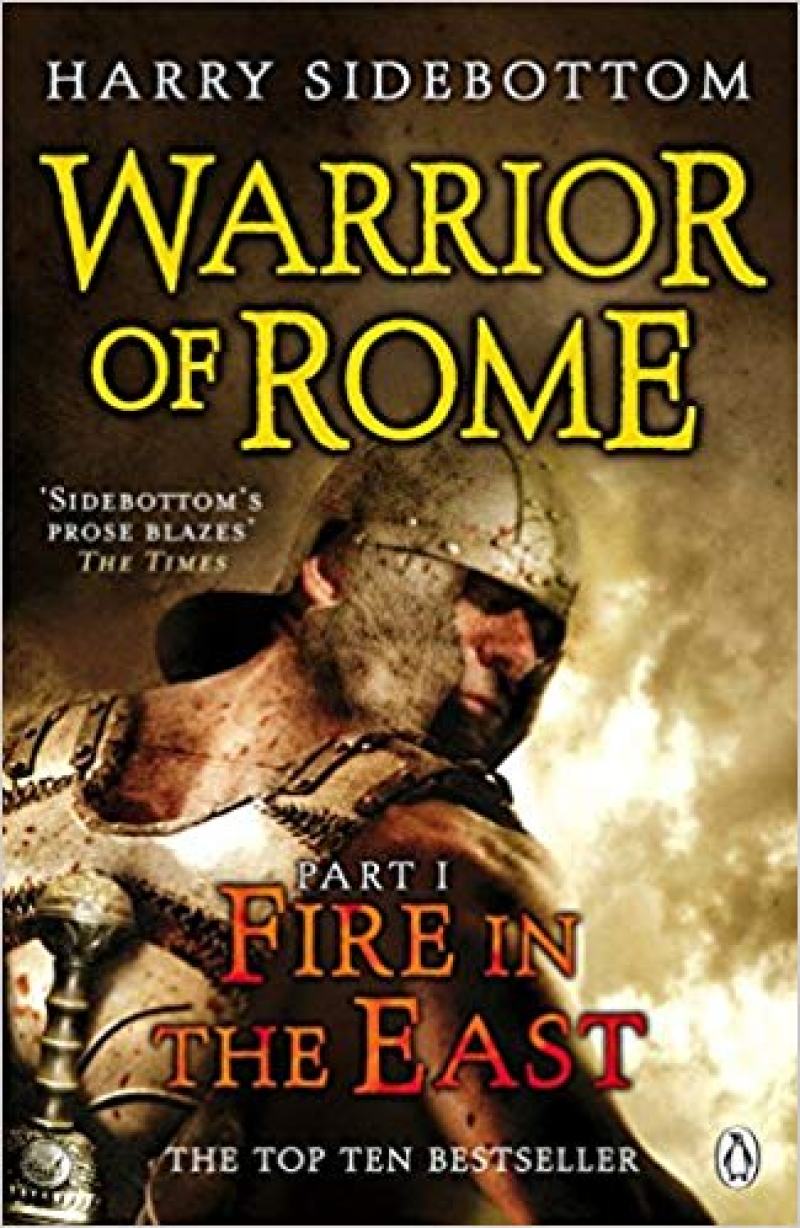
2008 MICHAEL JOSEPH | FIRE IN THE EAST is the first instalment in the immense grand narrative of the WARRIOR OF ROME series: a trilogy spanning the first tumultuous events of the decline of the Roman Empire. AD255 – the Roman Imperium is stretched to breaking point, its authority and might challenged throughout the territories and along every border. Yet the most lethal threat lurks far to the east in Persia, where the massing forces of the Sassanid Empire loom with fiery menace. The far flung and isolated citadel of Arête faces out across the wasteland, awaiting the inevitable invasion. One man is sent to martial the defences of this lonely city – one man to shore up the crumbling walls of a once indomitable symbol of Roman power – a man whose name itself means war, a man called Marcus Clodius Ballista. Alone, Ballista is called to muster the forces and the courage to stand first and to stand hard against greatest enemy ever to confront the Imperium. |
2019 ZAFFRE | When Valens, a junior officer in the Roman Army, joins a crack squad of soldiers on a dangerous mission, little does he know what's in store for him. Tasked with rescuing the young Prince Sasan, who has been imprisoned in the impenetrable Castle of Silence, the troops set out across Mesopotamia and into the mountains south of the Caspian Sea. Deep in hostile territory, inexperienced Valens finds himself in charge. And as one by one his soldiers die or disappear, he begins to suspect that there is a traitor in their midst, and that the rescue is fast becoming a suicide mission. Valens must marshal this disparate group of men and earn their respect, before it's too late . . . |
Non-Fiction
| Publication Details | Notes |
|---|---|
2004 OUP | Greek and Roman warfare differed from that of other cultures and was unlike any other forms of warfare before and after. The key difference is often held to be that the Greeks and Romans practised a 'Western Way of War', where the aim is an open, decisive battle, won by courage instilled in part by discipline. Harry Sidebottom looks at how and why this 'Western Way of War' was constructed and maintained by the Greeks and Romans, why this concept is so popular and prevalent today, and at whether or not this is an accurate interpretation. All aspects of ancient warfare are thoroughly examined - -from philosophy and strategy to the technical skills needed to fight. He looks at war in the wider context - how wars could shape classical society, and how the individual's identity could be constructed by war, for example the Christian soldier fighting in God's name. He also explores the ways in which ancient society thought about conflict: Can a war be just? Why was siege warfare particularly bloody? What role did divine intervention play in the outcome of a battle? “A thoughtful and thought-provoking discussion of the way in which the ancient Greeks and Romans thought about warfare and how they used war to think about society and their place in the world. In this sense it is a radical and fresh reading of Greek and Roman warfare that is both surprising and stimulating. … This is a little book which is jam-packed with both ideas and insight” “In this well written and equally well organised survey Dr Sidebottom gives readers a sound introduction to warfare in this period. … Despite its brevity, this book is a tour de force.” “Harry Sidebottom fairly presumes you wouldn’t know a Hoplite if one thrust a spear at you, and that you grasped legionary tactics from watching the DVD of GLADIATOR: he uses our instinctive understanding of what has been sold since classical Greece as the “western way of war” as the basis for a boot-camp for the brain – a short, sharp shock to presumptions. The book manages to practical fighting from the Iliad to Islam’s challenge to Byzantium; was as personal and state metaphor in Greece and Rome; strategy and motivation on sea and land; then nips briskly on to historians’ re-evaluations of the above – in 128 neat pages plus extra reading list and a wicked chronology. Got that? Right, then. Fall in." |